Office air counted acceptable lowers performance by an estimated 5 to 10%
Adults lose an estimated 5 to 10% of their performance in indoor conditions that current practice accepts. The indoor-environment researcher Pawel Wargocki and the indoor-climate researcher David Wyon drew this range in 2017 from lab and field work going back to the 1970s. In May 2026, I analysed 27 sources for [a report for The Built Review](https://thebuiltreview.com/reports/what-your-office-costs) on four design choices with a measured effect on the people in an office: air, speech, light and the view of nature.
Written by
Christian Huser
neuecon partners
The person who sets the ventilation rate in a developer's office does not sit at the desks that the rate affects.
Much of the office stock needs substantial retrofit
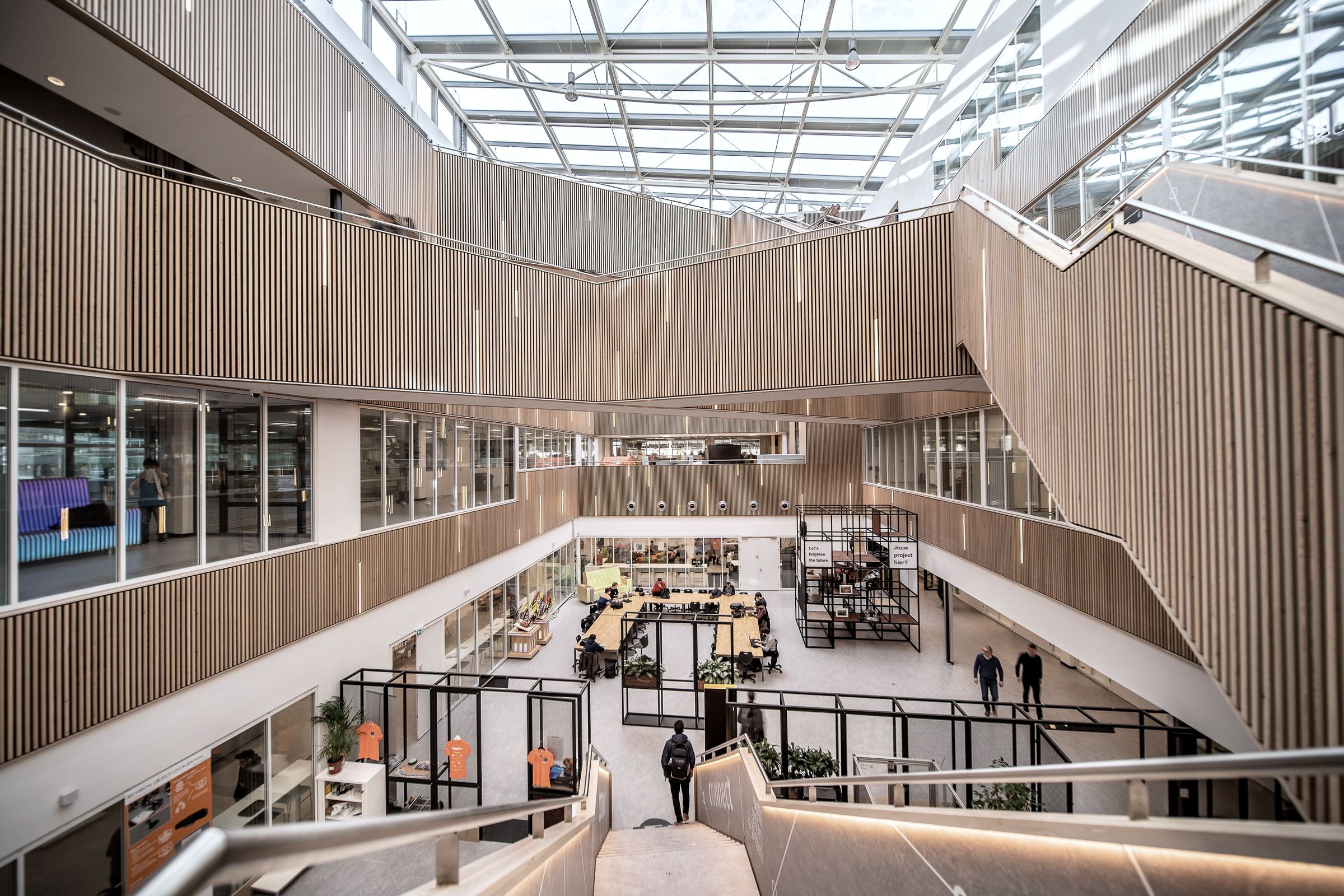
Every retrofit sets the indoor conditions for the people who will work in the building. The real estate services firm JLL put the office space of 66 markets at about 776 million m² in 2024 and estimated that 322 to 425 million m² of it need substantial retrofit. The recast EU Energy Performance of Buildings Directive, in force since 28 May 2024, brings indoor environmental quality into the directive for the first time.
Office owners and tenants measure occupancy in hours per desk per week, and none of the sources I analysed showed one who measures how well the people at those desks make decisions.
The largest effect of air comes from one test chamber
The environmental health researcher Joseph Allen and colleagues tested 24 office workers in a chamber in Syracuse in 2016, on six days in three air conditions. They scored decision-making with the Strategic Management Simulation, as an average across nine areas of thinking. With doubled ventilation and about 550 parts per million (ppm) of carbon dioxide, the workers scored 101% higher than in the conventional condition of about 945 ppm. I read the 101% as the likely upper end of the effect. The study's sponsor, United Technologies / Carrier, makes heating, ventilation and air conditioning systems.
Submariners showed no such effect. The psychologist Christopher Rodeheffer and colleagues gave the same test to 36 of them in 2018, at three levels of carbon dioxide, the highest at 15,000 ppm, an order of magnitude above the office range. On none of the nine measures did the scores differ by more than chance could explain. Rodeheffer names the selected sample of submariners as a limit of his study.
Speech is the part of office noise that disturbs memory
The human-factors researcher Simon Banbury and the psychologist Dianne Berry played office noise to participants in three lab experiments in 1998. With speech in it, the noise impaired both mental arithmetic and memory for a text the participants had read; without speech, it impaired only the arithmetic. The meaning of the words made no difference.
When the occupational health researcher Annu Haapakangas and colleagues combined the answers of 883 workers with acoustic measurements of their 21 open-plan offices in 2017, the best predictor of disturbance was the distance over which speech stays intelligible. Background noise and sound absorption had no effect of their own.
Daylight at work went with better sleep
The architecture researcher Mohamed Boubekri and colleagues ran a pilot study with 49 office workers in 2014 and recorded the sleep of 21 of them with motion sensors. Among those 21, workers at a window desk slept 46 minutes more on work nights than workers at a windowless desk.
For seven days in winter and seven in summer, the lighting researcher Mariana Figueiro and colleagues measured the light at eye level of 109 workers in five federal office buildings of the US General Services Administration. Workers who got more of the morning light that acts on the body clock fell asleep faster, mainly in winter, and rated their sleep better. Figueiro published this in 2017 from observations in the workers' own offices, so it shows an association.
The office studies on nature tested plants
Of the four design choices, the view of nature had the least office evidence in the sources I analysed. The psychologist Andrew Thatcher and colleagues found in 2020 that plants raised performance in a lab but made no difference to performance or well-being in two call centres over 6 and 14 weeks. The vendor Execuflora supplied the plants, and the call-centre result runs against its commercial interest.
The energy for better air costs little next to labour
The person who sets the ventilation rate in a developer's office does not sit at the desks that the rate affects. Allen calls this a split incentive.
Wargocki and Wyon write that labour costs exceed energy costs by two orders of magnitude. The environmental health researcher Piers MacNaughton and colleagues modelled in 2015 what it would cost the owner to double the ventilation, from the minimum of 20 cubic feet of air per minute per person that they took from the US engineering society ASHRAE to 40. The extra energy came to USD 7.83 to 39.87 per person per year, depending on the climate zone. United Technologies / Carrier funded this model too.
The only rent figure in the sources I analysed comes from a working paper, and I found no peer-reviewed version of it. The real estate analyst Natasha Sadikin and colleagues used lease data from CompStak for ten US cities in 2021 and found that top-grade offices with a Fitwel or WELL health certificate let for 4.4 to 7.7% more rent, net of incentives, than comparable top-grade offices without one.
The test belongs in occupied offices
I use Wargocki and Wyon's range for the loss from air because they call it conservative and no manufacturer funded their work. Haapakangas and Figueiro also measured people in real offices without manufacturer funding, and I think their work shows that intelligible speech and morning light affect the people in an office. My recommendation to owners and tenants is to give the people in their own offices the Strategic Management Simulation, the test that Allen and Rodeheffer used.
Sources
- Wargocki and Wyon 2017, "Ten questions concerning thermal and indoor air quality effects on the performance of office work and schoolwork", Building and Environment 112:359-366. https://doi.org/10.1016/j.buildenv.2016.11.020
- Allen and colleagues 2016, "Associations of Cognitive Function Scores with Carbon Dioxide, Ventilation, and Volatile Organic Compound Exposures in Office Workers: A Controlled Exposure Study of Green and Conventional Office Environments", Environmental Health Perspectives 124:805-812. https://doi.org/10.1289/ehp.1510037
- Rodeheffer and colleagues 2018, "Acute Exposure to Low-to-Moderate Carbon Dioxide Levels and Submariner Decision Making", Aerospace Medicine and Human Performance 89:520-525. https://doi.org/10.3357/AMHP.5010.2018
- Banbury and Berry 1998, "Disruption of office-related tasks by speech and office noise", British Journal of Psychology 89:499-517. https://doi.org/10.1111/j.2044-8295.1998.tb02699.x
- Haapakangas and colleagues 2017, "Distraction distance and perceived disturbance by noise: An analysis of 21 open-plan offices", Journal of the Acoustical Society of America 141:127-136. https://doi.org/10.1121/1.4973690
- Boubekri and colleagues 2014, "Impact of Windows and Daylight Exposure on Overall Health and Sleep Quality of Office Workers: A Case-Control Pilot Study", Journal of Clinical Sleep Medicine 10:603-611. https://doi.org/10.5664/jcsm.3780
- Figueiro and colleagues 2017, "The impact of daytime light exposures on sleep and mood in office workers", Sleep Health 3:204-215. https://doi.org/10.1016/j.sleh.2017.03.005
- Thatcher and colleagues 2020, "Do indoor plants improve performance and well-being in offices? Divergent results from laboratory and field studies", Journal of Environmental Psychology 71:101487. https://doi.org/10.1016/j.jenvp.2020.101487
- MacNaughton and colleagues 2015, "Economic, Environmental and Health Implications of Enhanced Ventilation in Office Buildings", International Journal of Environmental Research and Public Health 12(11):14709-14722. https://doi.org/10.3390/ijerph121114709
- Sadikin and colleagues 2021, "The Financial Impact of Healthy Buildings: Rental Prices and Market Dynamics in Commercial Office", SSRN Working Paper 3784779. https://doi.org/10.2139/ssrn.3784779
- JLL 2024, "Opportunity through Obsolescence". https://www.jll.com/en-us/insights/opportunity-through-obsolescence
- Directive (EU) 2024/1275 on the energy performance of buildings (recast). https://eur-lex.europa.eu/eli/dir/2024/1275/oj
- Living on Earth, interview with Joseph Allen, 7 August 2020. http://www.loe.org/shows/segments.html?programID=20-P13-00032&segmentID=6
- The Built Review, "Four design choices that change office work", report, May 2026. https://thebuiltreview.com/reports/what-your-office-costs