Daylight on a ward went with less pain medication after surgery
After spine surgery, patients on the bright side of one hospital ward took 22% less pain medication per hour than patients on its dark side. The pathologist Jeffrey Walch and colleagues followed these 89 patients in 2005. The researchers assigned no patient to a side at random.
Written by
Christian Huser
neuecon partners
I think that whoever plans or finances a hospital should enter the effect of the room on recovery and on staff strain as a figure, with its uncertainty stated.
The room is missing from the plan
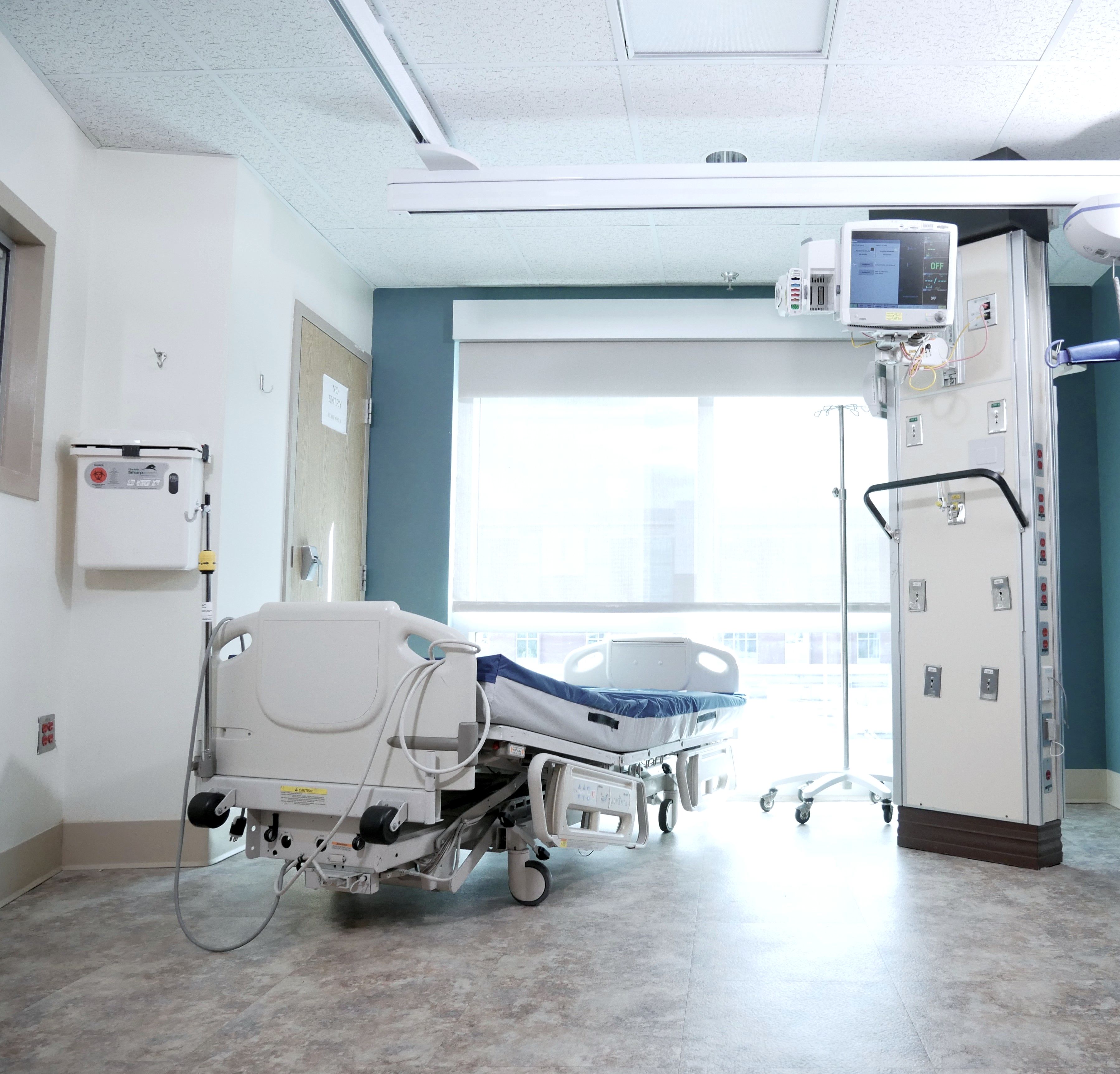
In March 2026, I analysed twelve sources, published between 1984 and 2025, for a report for The Built Review on how the hospital room affects the recovery of patients and the strain on staff. Wherever a study measured recovery or strain, patients or staff did better in the room with more daylight or greenery. The studies were small: 89 patients in one, 21 nurses in another. Hospital planners calculate the investment from floor area and number of beds, and the authorities grant the permit on hygiene and fire safety.
A fixed payment per case rewards a shorter stay
In Germany, in comparable European systems and in the US, a hospital receives a fixed amount per case, set by the patient's Diagnosis-Related Group (DRG), which groups cases with a similar diagnosis and treatment. A shorter stay lowers what each case costs the hospital. Pain medication comes out of the same fixed amount, so lower demand for it lowers the cost too. Staff absence is a cost of its own, and the current shortage of nurses makes it dearer.
Sun on one side of a ward
The clearest figure comes from a ward whose two sides got different amounts of sun. Before the study, the hospital had put each of Walch's 89 patients on the bright or the dark side, and the bright side received 46% more sunlight. Patients there took 22% less pain medication per hour, their pain medication cost 21% less, and they reported less stress. Both figures had a p value of 0.047, just under the 0.05 below which researchers conventionally stop putting a difference down to chance.
The team measured sun exposure and no other feature of the room. Because the hospital chose each patient's side, another difference between the two sides may explain part of the result.
In studies of Maggie's Centres, patients put daylight first
Patients rank daylight first too. In 2023, the architecture researcher Bekir Hüseyin Tekin and colleagues merged the published qualitative studies, which record what people say and do, of Maggie's Centres in the UK: house-like buildings with gardens and domestic rooms, which cancer patients visit between treatments. Patients put fresh air and greenery close behind daylight, while staff put privacy and quiet first. These studies give no figure for the size of any effect.
Trees outside the window
In 1984, the geographer Roger Ulrich compared patients after surgery whose window looked onto trees with patients whose window faced a brick wall. The patients with a view of trees had shorter stays and took less potent painkillers. Other researchers have rarely repeated the study directly.
A 2024 review points the same way
The pattern holds beyond single wards, but the studies behind it are uneven. In 2024, the industrial engineer Inas Al Khatib and colleagues searched by stated rules for all hospital studies from 2010 to 2023 on biophilic design, design that brings nature into the building. In these studies, biophilic design went with shorter stays and less pain relief after surgery, and with less stress among staff. In this material, I could not consistently tell whether the room caused a result or only went with it.
What the room did for staff
Staff took fewer hours off after an intensive care unit in New Hampshire moved into new, daylit rooms. In 2012, the architecture researcher Mardelle Shepley and colleagues compared absence before and after the move: 38 hours per person on average over the study period in the old unit, 23 hours in the new one. The result sat exactly on the conventional line for chance, at a p value of 0.05. The new unit differed from the old one in more than its daylight, and the team could not separate the daylight from the rest.
In 2025, the landscape architecture researcher ChoHye Youn and colleagues put 21 nurses from a hospital in Cheon-An, South Korea, for 10 minutes each into a fully planted room and into a white room without plants. With near-infrared light through the skull, they measured the oxygen in the blood of the dorsolateral prefrontal cortex, a region at the front of the brain. The oxygen was lower in the planted room, with a p value below 0.001, which leaves chance an unlikely explanation. I read the drop as a sign of less mental effort. Youn and colleagues measured no effect on health or absence, and 21 nurses are too few to generalise from.
Bacteria and fungi around a green wall were above normal levels
A green wall can bring moulds onto a ward. In 2021, the infectious-diseases physician Bernard Surial and colleagues examined a vertical green wall in a Swiss hospital. They found bacteria and fungi above normal levels in the air around it, on its surface and in its irrigation water, among them the moulds Aspergillus niger and Aspergillus terreus. After the measurement, the hospital's infection prevention committee dropped any further indoor planting.
In 2003, the infection control researcher Lynne Sehulster and the infectious-diseases physician Raymond Chinn wrote the guideline on environmental infection control for the US Centers for Disease Control and Prevention (CDC) and its Healthcare Infection Control Practices Advisory Committee. It recommends keeping fresh or dried flowers and potted plants out of the rooms of patients with a weakened immune system and allows them for other patients. Both recommendations are Category II, the guideline's grade for a measure it suggests on the strength of suggestive clinical or epidemiological studies or a theoretical rationale.
The room belongs in the calculation as an estimate
Case payment already prices what these studies measured. I think that whoever plans or finances a hospital should enter the effect of the room on recovery and on staff strain as a figure, with its uncertainty stated. I would start with Walch's 22%, measured on one ward with 89 patients, and Shepley's fall from 38 to 23 hours, measured after one move at a p value of 0.05. Each figure stays an estimate until someone publishes a comparison of case costs or a randomised trial. None of the twelve sources compared the DRG case costs of a hospital built with biophilic design with those of a conventional one, and none was a randomised trial in a hospital.
Sources
- Walch, Rabin, Day, Williams, Choi and Kang 2005, "The Effect of Sunlight on Postoperative Analgesic Medication Use: A Prospective Study of Patients Undergoing Spinal Surgery", Psychosomatic Medicine 67(1):156-163. https://doi.org/10.1097/01.psy.0000149258.42508.70
- Ulrich 1984, "View Through a Window May Influence Recovery from Surgery", Science 224(4647):420-421. https://doi.org/10.1126/science.6143402
- Tekin, Corcoran and Urbano Gutiérrez 2023, "The impact of biophilic design in Maggie's Centres: A meta-synthesis analysis", Frontiers of Architectural Research 12(1):188-207. https://doi.org/10.1016/j.foar.2022.06.013
- Al Khatib, Samara and Ndiaye 2024, "A systematic review of the impact of therapeutical biophilic design on health and wellbeing of patients and care providers in healthcare services settings", Frontiers in Built Environment 10:1467692. https://doi.org/10.3389/fbuil.2024.1467692
- Shepley, Gerbi, Watson, Imgrund and Sagha-Zadeh 2012, "The Impact of Daylight and Views on ICU Patients and Staff", HERD: Health Environments Research & Design Journal 5(2):46-60. https://doi.org/10.1177/193758671200500205
- Youn, Kang and Lee 2025, "Biophilic Design and Restorative Effects: A Neuropsychological Study of Healthy Indoor Workspaces in Urban Contexts", International Journal of Environmental Research and Public Health 22(10):1571. https://doi.org/10.3390/ijerph22101571
- Surial, Vázquez, Steiger, Rolli, Brand, Mühlethaler and Marschall 2021, "Assessing the infection risk of a vertical garden in a hospital setting", Infection Control & Hospital Epidemiology 43(2):273-275. https://doi.org/10.1017/ice.2020.1421
- Sehulster and Chinn 2003, "Guidelines for Environmental Infection Control in Health-Care Facilities: Recommendations of CDC and the Healthcare Infection Control Practices Advisory Committee (HICPAC)", MMWR Recommendations and Reports 52(RR-10). https://www.cdc.gov/mmwr/preview/mmwrhtml/rr5210a1.htm
- The Built Review, "How the hospital room affects recovery", report, March 2026. https://thebuiltreview.com/reports/healthcares-building-turn