Schools and hospitals have the best evidence for window views
A view of trees went with shorter hospital stays after surgery, and a better classroom view went with higher test results. For offices, I found one small measured effect on absence.
Written by
Christian Huser
neuecon partners
For a building project, I would plan with two findings: access to a view and control of glare.
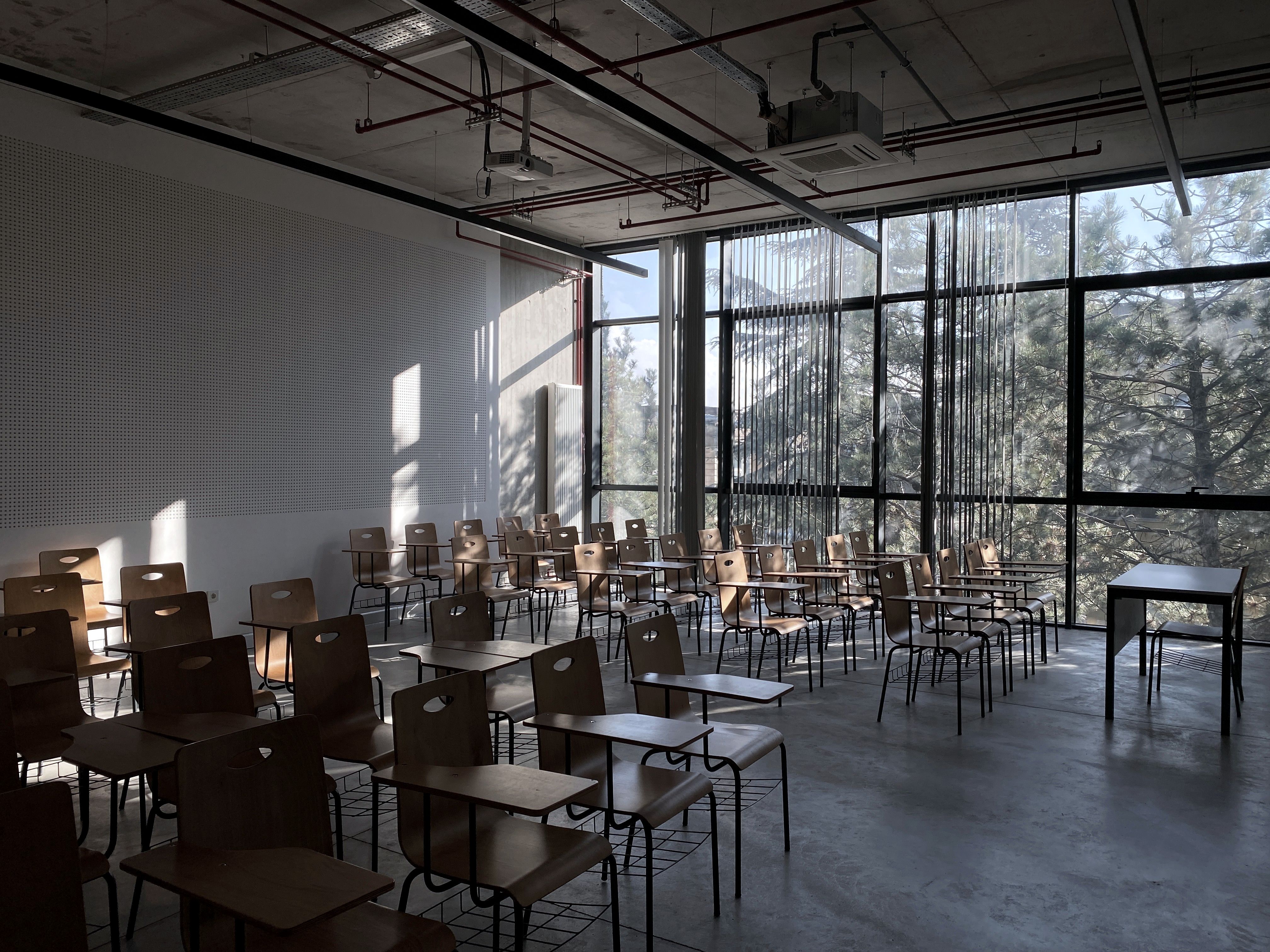
In June 2026, I analysed 29 sources on the business case for biophilic design for a report for The Built Review. Biophilic design brings plants, daylight and views of nature into buildings. Only one of the 29 sources measured absence on payroll records, and it studied a single building in Oregon.
One Oregon building supplies the payroll evidence
Employees with a poor view and poor lighting took more sick leave. In 2011, the architecture researcher Ihab Elzeyadi compared two years of payroll sick-leave records of 119 employees in a university building from the 1970s with the window view and lighting quality each of them had. Those with the best view and lighting used 53 hours of sick leave a year, those with the worst 71 hours, 18 hours more.
The effect is small. View alone explained about 4.5% of the differences in sick leave between the employees, and view and lighting together 6.5%, while by the common convention a share of 26% or more counts as large. Elzeyadi compared the employees with each other at one time and followed no change, so his data show only that view and absence went together.
Workers rated their own wellbeing higher in offices with natural elements
An office survey funded by a carpet maker adds self-ratings but no new absence data. In 2015, the organisational psychologist Cary Cooper and colleagues surveyed 7,600 office workers in 16 countries for Human Spaces, a research programme funded by Interface, a maker of carpet tiles. Workers in offices with natural elements rated their own wellbeing 15% higher, their productivity 6% higher and their creativity 15% higher than workers in offices without them. For sick leave, Cooper and colleagues cite Elzeyadi's Oregon building.
The classroom daylight rating explained little in Fresno
The classroom figures for daylight rest on one of three districts. In 1999, the architect Lisa Heschong and her firm, the Heschong Mahone Group, analysed the test scores of 21,344 primary-school pupils in Capistrano in California, Seattle and Fort Collins, for Pacific Gas and Electric and the California Board for Energy Efficiency. Only in Capistrano, in Orange County, could the group follow pupils across a school year, 8,166 of them. There, pupils in the classrooms rated highest for daylight progressed 20% faster in maths and 26% faster in reading than pupils in the classrooms rated lowest. The group called its design correlational, because it compared classrooms as they were and did not study why daylight and progress went together.
In 2003, the group analysed the Capistrano data again for the California Energy Commission. The middle estimate across twelve statistical models was 21% faster learning, and the group ruled out a bias from the way schools assigned teachers to classrooms.
The same year, the group studied more than 8,000 pupils in Fresno, again for the California Energy Commission, and there the daylight rating had "the least explanatory power of the set of variables considered". Pupils scored higher where the window gave a better view and lower where glare or direct sun entered the room. The group suspected that its 1999 daylight rating had also measured differences in classroom acoustics.
A national saving built on one hospital study misreads its table
Among my 29 sources, one primary study measured the effect of a view in hospitals. In 1984, the environmental psychologist Roger Ulrich compared patients after surgery whose windows faced trees with patients whose windows faced a brick wall. The patients facing trees left hospital three quarters of a day earlier and needed less potent painkillers.
In 2012, Terrapin Bright Green, a New York consultancy that sells biophilic design strategy, used this study in its report The Economics of Biophilia to estimate savings of USD 93 million a year to US healthcare. Terrapin multiplied the shorter stay by 44,993 surgical procedures from a hospital survey by the CDC, the US public health agency. The CDC table counts procedures in thousands, so the figure stands for roughly 45 million procedures, and with it Terrapin's calculation gives about USD 93 billion. I found no published correction.
Office landlords earn a measured premium for certificates
Certified offices let and sell for more. In 2010, the real estate economist Piet Eichholtz and colleagues compared green-certified US offices with control buildings in the same locations. The certified offices let for rents about 3% higher and sold for prices about 16% higher. Two years later, the real estate researcher Alexander Reichardt and colleagues used panel models, which follow the same buildings over several years and so hold constant the traits of a building that the data do not record. They found rent premiums of 2.5% for Energy Star, the US energy label, and 2.9% for LEED, a green building rating. In 2023, the broker JLL reported a rent premium of 7.1% for green-certified Class A offices, the top grade of office space, in North America.
These premiums may be inflated. In 2018, the real estate researchers Ben Dalton and Franz Fuerst pooled the premium studies and warned of a selection effect: certified buildings are newer and better located in ways the models miss. They also warned of publication bias, the tendency of studies that find an effect to reach print more often, and called the literature "disjointed and at least partly inconclusive". I found no study that ruled out the selection effect, and none that measured a price for planting, views or other biophilic features in offices apart from certification.
Uptake figures come from firms that sell biophilic design
Every percentage on the spread of biophilic design that I could trace came from a firm that sells it. In 2023, the construction researcher Abdul-Manan Sadick and colleagues interviewed practitioners in Australia, who described the uptake of biophilic design as limited and named budget restrictions, maintenance load and the influence of clients as obstacles. Sadick and the construction researcher Imriyas Kamardeen followed with a second study on uptake in 2024.
I think buyers are right to go slowly
The one effect measured on office payroll records, Elzeyadi's 6.5%, is small, and the evidence for views comes mostly from schools and hospitals. Terrapin's USD 93 million came from a firm that sells biophilic design. I found no building code in the markets The Built Review covers that required biophilic features.
A school or a hospital that adds views can check the result in data it already keeps: test results, the measure of the Heschong Mahone Group, and length of stay, the measure of Ulrich.
For a building project, I would plan with two findings: access to a view and control of glare. For rent, I would use the premiums of 2.5 to 2.9% from the panel models of Reichardt and colleagues. I count JLL's 7.1% and the 16% sale premium of Eichholtz and colleagues as unproven until a study rules out the selection effect that Dalton and Fuerst raised in 2018.
Sources
- Elzeyadi 2011, "Daylighting-Bias and Biophilia: Quantifying the Impact of Daylighting on Occupants Health", Greenbuild 2011 Proceedings, USGBC Press. https://www.usgbc.org/sites/default/files/OR10_Daylighting%20Bias%20and%20Biophilia.pdf
- Human Spaces 2015, "Human Spaces: The Global Impact of Biophilic Design in the Workplace", Interface. https://www.interface.com/content/dam/interfaceinc/interface/global-campaigns/human-spaces/report/global-human-spaces-report/Human%20Spaces%20report%202015%20EN.pdf
- Heschong Mahone Group 1999, "Daylighting in Schools: An Investigation into the Relationship between Daylighting and Human Performance", report for Pacific Gas and Electric on behalf of the California Board for Energy Efficiency. https://files.eric.ed.gov/fulltext/ED444337.pdf
- Heschong Mahone Group 2003, "Daylighting in Schools: Reanalysis Report", California Energy Commission, P500-03-082-A-3. https://filesnewbuilding.s3.amazonaws.com/wp-content/uploads/2015/11/A-3_Dayltg_Schools_2.2.51.pdf
- Heschong Mahone Group 2003, "Windows and Classrooms: A Study of Student Performance and the Indoor Environment", California Energy Commission, P500-03-082-A-7. https://newbuildings.org/resource/windows-and-classrooms/
- Ulrich 1984, "View Through a Window May Influence Recovery from Surgery", Science 224(4647):420-421. https://doi.org/10.1126/science.6143402
- Terrapin Bright Green 2012, "The Economics of Biophilia: Why designing with nature in mind makes financial sense". https://www.terrapinbrightgreen.com/reports/the-economics-of-biophilia/
- Hall and colleagues 2010, "National Hospital Discharge Survey: 2007 Summary", National Health Statistics Reports 29, CDC. https://www.cdc.gov/nchs/data/nhsr/nhsr029.pdf
- Eichholtz, Kok and Quigley 2010, "Doing Well by Doing Good? Green Office Buildings", American Economic Review 100(5):2492-2509. https://doi.org/10.1257/aer.100.5.2492
- Reichardt, Fuerst, Rottke and Zietz 2012, "Sustainable Building Certification and the Rent Premium: A Panel Data Approach", Journal of Real Estate Research 34(1):99-126. https://doi.org/10.1080/10835547.2012.12091325
- JLL 2023, "The commercial case for making buildings more sustainable", JLL Research. https://www.jll.com/en-uk/insights/the-commercial-case-for-sustainable-buildings
- Dalton and Fuerst 2018, "The 'green value' proposition in real estate", Routledge Handbook of Sustainable Real Estate, 177-200. https://doi.org/10.1201/9781315622750-12
- Sadick, Kamardeen and Vu 2023, "Challenges for implementing biophilic strategies in Australian building design", Journal of Building Engineering 74:106849. https://doi.org/10.1016/j.jobe.2023.106849
- Sadick and Kamardeen 2024, "Enablers for accelerating biophilic design adoption in Australian buildings", Journal of Building Engineering 83:108464. https://doi.org/10.1016/j.jobe.2024.108464
- The Built Review, "Checking the biophilia business case", report, June 2026. https://thebuiltreview.com/reports/biophilia-adoption-gap