In open-plan offices, speech that people can understand lowers performance
Performance in lab tests began to fall once background speech reached about 0.21 on the speech transmission index, a scale that runs from 0, at which a listener understands no word, to 1, at which a listener understands every word. The occupational health researcher Annu Haapakangas and colleagues found this threshold in 2020 in a review of 14 lab studies.
Written by
Christian Huser
neuecon partners
I would design areas for focused work to stay at or below a speech transmission index of about 0.21.
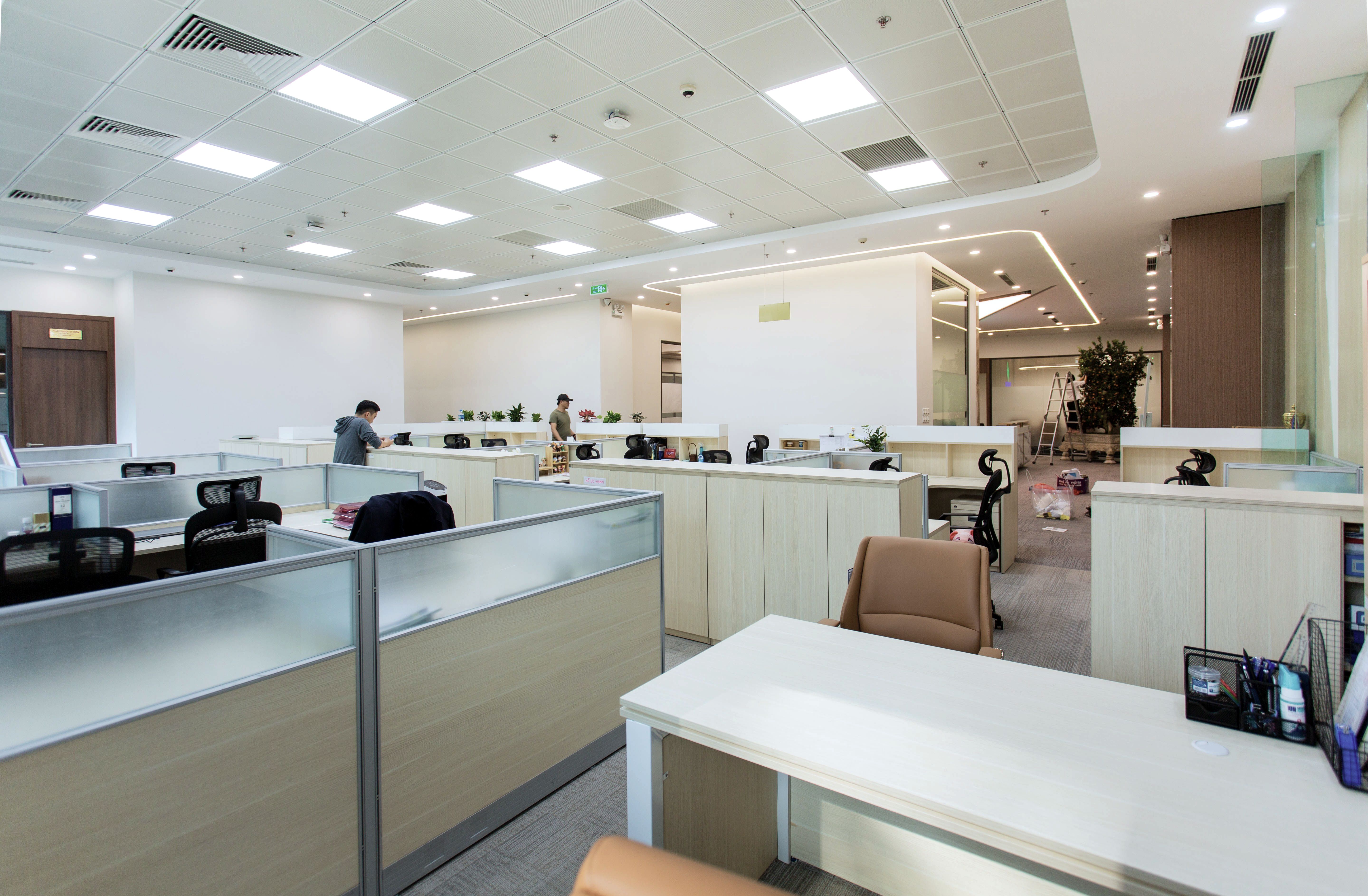
Staff who moved into open plan rated the work they lost to noise twice as high
In July 2026, I analysed 33 studies on noise and performance for a report for The Built Review. Much of the evidence from real offices comes from what staff report about themselves. In 2009, the indoor-environment researcher Anu Kaarlela-Tuomaala and colleagues followed the staff of one Finnish workplace from private rooms into open plan. After the move, the staff reported more distraction and more trouble concentrating. The loss of work performance that they put down to noise doubled. The researchers had no audited measure of output.
In a survey of workers in office buildings in several European countries, the mechanical engineer Ioannis Sakellaris and colleagues found in 2016 that satisfaction with noise had the strongest link with overall comfort, ahead of air quality, light and temperature.
Disturbance followed how far clear speech carried
When workers in 21 open-plan offices judged how noisy their office was, distracting background speech largely explained their answer. Haapakangas and colleagues, who combined these surveys with acoustic measurements in 2017, also measured the distraction distance: how far from a talker speech stays clear enough to distract. That distance predicted how disturbed the workers felt. The authors wrote that the other acoustic measures may not be linked to disturbance on their own.
The lab studies in the 2020 review locate the largest drop in performance at an index of about 0.44. Verbal short-term memory, which holds words in mind for a short time, was the most affected task and the most consistent across studies.
Turning speech down was not enough in the lab
Soft speech that was easy to understand still disrupted verbal short-term memory and mental arithmetic in the experiments of the psychologist Sabine Schlittmeier and colleagues in 2008. Soft speech that was hard to understand disrupted both tasks only a little.
In 2015, the acoustics researcher Marijke Keus van de Poll and colleagues found that a single voice impaired memory compared with silence. When they masked that voice with several other voices, performance returned to the level of silence.
Whether the meaning of the words does the harm is still open. In 1990, the psychologist Dylan Jones and colleagues found that irrelevant speech impaired proofreading only when the speech was meaningful and the load on short-term memory was low. In 1998, the human-factors researcher Simon Banbury and the psychologist Dianne Berry found that office noise disrupted arithmetic with or without speech. It disrupted memory only when it contained speech. In their study, the disruption did not depend on what the speech meant.
The harm varied with the person and with the task
In 2019, the built-environment researcher Michael Roskams and colleagues surveyed 166 knowledge workers at three open-plan sites. Noise sensitivity largely explained how comfortable each worker found the acoustics. Comfort varied widely between people, and the more sensitive workers rated the acoustics worse and reported more disturbance by speech and more trouble concentrating.
In 2014, the psychologist Niklas Halin and colleagues had people read texts in quiet or with background speech, in an easy-to-read or a hard-to-read font. Speech lowered what the readers remembered only when the font was easy to read. Halin and colleagues wrote that a harder task makes readers focus on it. I had only the abstracts of the studies by Roskams and Halin.
Little is known about which acoustic remedies work
The acoustics researcher Jikke Reinten and colleagues reviewed the research on sound and task performance in 2017 and concluded that evidence on which strategies of room acoustics work was lacking. In 2022, the acoustics researcher Benjamin Mueller and colleagues tested active noise-cancelling headphones. With the headphones, people rated their privacy and their acoustic surroundings better. Their measured cognitive performance did not change.
Intelligibility is the measure I would design against
I think office noise harms work more, the better people can understand the speech near them. I would design areas for focused work to stay at or below a speech transmission index of about 0.21. That value comes from lab tasks with steady masking noise.
I would call an absorber or a masking system a remedy only after its effect has been measured in the room where it is installed. Where quiet rooms or desks beyond the distraction distance of nearby talkers are scarce, I would give them first to noise-sensitive staff and to staff whose work is as undemanding as the easy-font reading in Halin's study. Pairing these two groups is my reading; I found no study that tested noise sensitivity and the difficulty of the task together.
Sources
- Haapakangas, Hongisto and Liebl 2020, "The relation between the intelligibility of irrelevant speech and cognitive performance: A revised model based on laboratory studies", Indoor Air 30:1130-1146. https://doi.org/10.1111/ina.12726
- Haapakangas and colleagues 2017, "Distraction distance and perceived disturbance by noise: An analysis of 21 open-plan offices", Journal of the Acoustical Society of America 141:127-136. https://doi.org/10.1121/1.4973690
- Kaarlela-Tuomaala and colleagues 2009, "Effects of acoustic environment on work in private office rooms and open-plan offices: longitudinal study during relocation", Ergonomics 52:1423-1444. https://doi.org/10.1080/00140130903154579
- Sakellaris and colleagues 2016, "Perceived Indoor Environment and Occupants' Comfort in European 'Modern' Office Buildings: The OFFICAIR Study", International Journal of Environmental Research and Public Health 13:444. https://doi.org/10.3390/ijerph13050444
- Schlittmeier and colleagues 2008, "The impact of background speech varying in intelligibility: Effects on cognitive performance and perceived disturbance", Ergonomics 51:719-736. https://doi.org/10.1080/00140130701745925
- Jones, Miles and Page 1990, "Disruption of proofreading by irrelevant speech: Effects of attention, arousal or memory?", Applied Cognitive Psychology 4:89-108. https://doi.org/10.1002/acp.2350040203
- Keus van de Poll and colleagues 2015, "Unmasking the effects of masking on performance: The potential of multiple-voice masking in the office environment", Journal of the Acoustical Society of America 138:807-816. https://doi.org/10.1121/1.4926904
- Banbury and Berry 1998, "Disruption of office-related tasks by speech and office noise", British Journal of Psychology 89:499-517. https://doi.org/10.1111/j.2044-8295.1998.tb02699.x
- Roskams and colleagues 2019, "Acoustic comfort in open-plan offices: the role of employee characteristics", Journal of Corporate Real Estate 21:254-270. https://doi.org/10.1108/JCRE-02-2019-0011
- Halin and colleagues 2014, "A shield against distraction", Journal of Applied Research in Memory and Cognition 3:31-36. https://doi.org/10.1016/j.jarmac.2014.01.003
- Reinten and colleagues 2017, "The indoor sound environment and human task performance: A literature review on the role of room acoustics", Building and Environment 123:315-332. https://doi.org/10.1016/j.buildenv.2017.07.005
- Mueller and colleagues 2022, "Using active noise-cancelling headphones in open-plan offices: No influence on cognitive performance but improvement of perceived privacy and acoustic environment", Frontiers in Built Environment 8. https://doi.org/10.3389/fbuil.2022.962462
- The Built Review, "Why open-plan offices break concentration", report, July 2026. https://thebuiltreview.com/reports/open-plan-speech