What a firm earns in a healthy building
In offices with cleaner air, workers answer cognitive tests faster and more accurately. Harvard's Healthy Buildings Program turns this into 10.7% more net income for a firm of 40 people by assuming 3% more revenue. None of the 18 sources I analysed measured revenue.
Written by
Christian Huser
neuecon partners
None of the 18 sources I analysed measured revenue.
Harvard's calculation assumes a 3% rise in revenue
Harvard's Healthy Buildings Program offers a calculator that estimates how a healthy building changes a firm's net income. It takes a firm of 40 employees with an average salary of 75,000 US dollars. If the firm invests in all the measures the program lists, the calculator shows a net income 10.7% above the firm's baseline. If the firm only saves energy, the calculator shows a net income 0.36% above the baseline.
The 10.7% depends on one input. The program assumes that the firm's revenue rises by 3%. From that gain, it subtracts a rent 10% higher for the healthy building.
Harvard's own study measured test scores
For the gain in productivity, the program links to its own study, CogFX. In 2021, the public health researcher Jose Guillermo Cedeño Laurent and colleagues followed 302 office workers in six countries for 12 months. When the office air held more fine particles and more carbon dioxide, the workers answered cognitive tests more slowly and less accurately. A high level of carbon dioxide indoors is a sign of little fresh air.
The researchers observed the workers in their own offices. They measured test scores. None of the sources I analysed measured whether higher test scores raise a firm's revenue.
Magazines wrote about the effect without a controlled study
In June 2026, design and wellness magazines wrote that buildings affect the brain and health. In a report for The Built Review in July 2026, I analysed 18 sources. I compared the month's articles with seven systematic reviews from the same quarter. A systematic review collects and rates all studies on one question. None of the articles linked a design change to a health result from a controlled study.
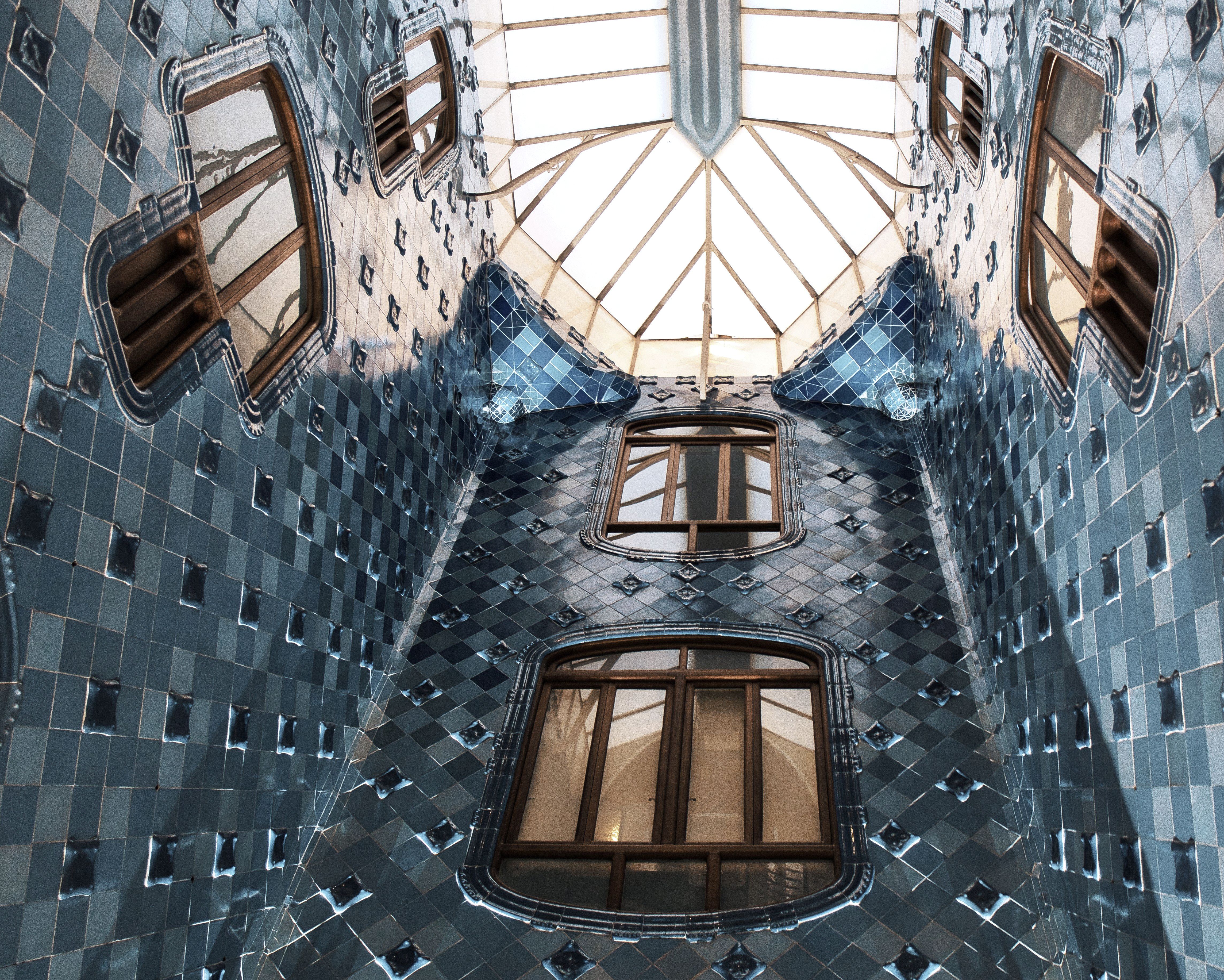
Two writers described rooms that make people feel unwell. In Psychology Today, Meredith Banasiak, director of research at the architecture firm Boulder Associates, wrote that a third of the visitors to one conference room in MIT's Stata Center feel dizzy. In Metropolis, the interior design educator Jaxson Stone, who has an autism diagnosis, described acute sensory overload in Casa Batlló in Barcelona. Casa Batlló says that 85% of the staff who meet visitors are neurodivergent, a word for people with autism, ADHD and similar conditions.
Programmes in nature lowered anxiety and depression
In 2026, the psychologist Esmaeel Saeedy Robat and colleagues pooled 116 systematic reviews. They combined the results of 30 of them in a meta-analysis, a calculation that merges the results of many studies into one figure. Programmes in nature lowered anxiety by a standardised mean difference of 0.83 and depression by 0.72. A standardised mean difference measures the gap between two groups in standard deviations, the usual spread of the scores. By the common convention, 0.8 or more counts as large. Most of the trials in these figures compared people in nature programmes with people who received no treatment. The authors write that the figures therefore say little about nature compared with another treatment.
In 2026, the anaesthesiology researcher Yun Liang and colleagues pooled 15 randomised trials with 809 adults. They compared exercise in nature with the same exercise indoors and with no exercise, on a combined measure of depression, anxiety and distress. People who exercised in nature scored 0.96 standard deviations better than people who did not exercise. People who exercised indoors scored 0.21 better than people who did not exercise, a difference that chance could explain. People who exercised in nature scored 0.75 better than people who exercised indoors. Liang and colleagues call this comparison exploratory until more trials compare the two settings directly.
Poor acoustics went with worse health in studies of low certainty
In 2026, the architecture researcher Jingyi Mu and colleagues reviewed 180 studies of sound and the people most sensitive to it: older adults, children, people with hearing loss and hospital patients. In all four groups, poor acoustics went with worse health, weaker cognition and lower mood. Mu and colleagues rated the certainty of most of these results as low or very low on GRADE, the scale of the GRADE Working Group on which reviewers rate how far the studies on one question can be trusted.
I think a study of revenue should test the 10.7%
I think CogFX shows that workers answer cognitive tests worse in offices with more fine particles and carbon dioxide. The 3% rise in revenue is an assumption, and the 10.7% depends on it. A firm that wants to know how much more it earns in a healthy building needs a study that measures revenue. The reviews of the quarter show that programmes in nature lowered anxiety and depression. Most of the trials in these reviews compared programmes in nature with no treatment.
Sources
- Saeedy Robat and colleagues 2026, "A systematic overview and second-order meta-analysis of nature-based interventions for stress, anxiety and depression", Nature Human Behaviour. https://doi.org/10.1038/s41562-026-02433-4
- Liang, Wei and Min 2026, "Comparative efficacy of green exercise versus indoor exercise for depression and anxiety: a systematic review and network meta-analysis", Frontiers in Public Health. https://doi.org/10.3389/fpubh.2026.1831073
- Mu, Qin and Wang 2026, "Effects of Acoustic Environments on Well-Being in Sensory-Vulnerable Populations: A Systematic Review", Journal of Multidisciplinary Healthcare. https://doi.org/10.2147/jmdh.s589528
- Cedeño Laurent and colleagues 2021, "Associations between acute exposures to PM2.5 and carbon dioxide indoors and cognitive function in office workers: a multicountry longitudinal prospective observational study", Environmental Research Letters. https://doi.org/10.1088/1748-9326/ac1bd8
- Harvard Healthy Buildings Program, "The Business of Healthy Buildings". https://healthybuildings.hsph.harvard.edu/research/indoor-air-quality/business-case/
- Banasiak 2026, "When Buildings Make Us Feel Unwell", Psychology Today. https://www.psychologytoday.com/us/blog/design-with-the-brain-in-mind/202606/when-buildings-make-us-feel-unwell
- Stone 2026, "Antoni Gaudí, On the Spectrum", Metropolis. https://metropolismag.com/viewpoints/antoni-gaudi-on-the-spectrum/
- The Built Review, "How much of nature's benefit is really the nature?", trend report Q3 2026, July 2026. https://thebuiltreview.com/trend/q3-2026